The Void Archetype: Endings, Beginnings and Surrender

Stepping Into the Void: The Archetype of Fertile Darkness
In today’s post we’re exploring The Void archetype; the liminal, formless space before transformation takes shape. The Void is often misunderstood as emptiness or failure, but when we explore it’s energy, and in particular its light aspects, we can experience it as a threshold where endings meet beginnings, where our intuition has the space to speak.
If you’re new here I’m Laura, a counsellor, ecotherapist, and a somatic trauma therapist. My offerings are all about supporting you to connect with yourself and the world around you. I work with archetypes in both my therapy practice and my Sacred Somatic Journeys series, which are audio guided practices that invite you to explore archetypal themes, ritual practice and nature connection, through attunement to the body.
I talk about archetypes and their origins, including where they appear in folklore and psychology, how to work with them and understanding their light and dark aspects here.
The Void archetype is something many of us meet instinctively during times of transition, uncertainty or inner upheaval. It’s full of potential, but only when we learn to stop resisting its vastness! In this post, we’ll look deeper into the nature of the Void, including its light and shadow aspects. I’ll also share some spiritual and psychological perspectives that treat this darkness as a generative force rather than something to escape.
The Archetypal Void
Etymologically, the word void is related to vacancy, vanity, vastness and waste. The Void is an archetype that I have frequently encountered. In the past my experiences with the void felt tumultuous. I resisted the not-knowing of it all, as I navigated change, crossed thresholds and moved through periods of transition.
We’re taught to fear the empty spaces in our lives; the moments where we can’t see what’s next and the dissolution of self in response to uncertainty, grief or transformation. We might frame this as loss, failure or stuckness and we rush to fill the silence, because the dark aspects of the void can feel unbearably vast. When we meet the void, we meet the limit of what we know about ourselves and the world.
When we connect with the light aspects of this archetype, we can understand it as potential; fertile ground, the pause between identities, the liminal space where old structures fall away so that new ones can take shape.
The Void appears across cultures as the place before creation. In Greek mythology, Chaos (or Khaos) is the first existence; a primordial deity that emerges at the dawn of creation.
In a modern context we understand Chaos to mean ‘disorder’ but the Chaos of myth is the cosmic, generative source of all things. From Chaos comes ‘Gaia’, the ancestral mother and the embodiment of Earth; Tartaros, the embodiment of the underworld; and Eros, the primal expression of love, whose energy sparks all of creation.
The void is liminal like barren soil in winter, where seeds root in darkness long before they rise toward the light. A place where surrender, rather than collapse, can open the path forward.
The Gestalt Therapy Perspective
In Gestalt therapy, one of the modalities I work with as a therapist, the fertile void is the spacious pause that appears within the ‘cycle of experience’. The Gestalt cycle of experience describes how we naturally move from sensing that something needs our attention, to focusing on it clearly, to taking meaningful action and completing it, and then returning to a place of rest within ourselves and our surroundings. This process is shaped by our ongoing relationship with the world around us (what Gestalt calls the field).
Rather than a collapse or numbing, The Fertile Void is a generative nothingness, where sensation, intuition and authentic desire can emerge. Fritz Perls, Laura Perls, and Paul Goodman, the founders of Gestalt therapy, describe the void as a natural space where new ideas, creativity and direction can grow. They also hold that, for that to happen, there needs to be presence; we have to be prepared to be in the void, without rushing past it, if anything new is to emerge.
Light and Dark Aspects
As I share in my post about archetypes, “each archetype has duel aspects; light and integrated, or dark and unintegrated. Both are part of its full expression. The light aspect shows the integrated qualities; the aspects that support growth, connection, and wellbeing. The dark aspect often emerges when patterns are outside of our awareness, or denied and pushed away.”
The light aspects of The Void Archetype are spaciousness, surrender, deep intuition, fertility, stillness, and the ability to trust the unseen. To connect with this we need to cultivate our capacity to rest in uncertaintanty, allowing transformation to emerge without force.
The dark aspects of the void archetype are Numbness, dissociation, stagnation, or fear of emptiness. This can be driven by or result in avoidance of action or responsibility, collapsing into despair or the belief that “nothing matters.” We become lost in the formlessness rather than being nourished by it.
When we meet the void archetype we might also encounter the limits of what we know about ourselves and the world. Can we anchor ourselves by viewing the void as a space that isn’t barren? A liminal space, like the Earth in autumn and winter, where seeds root in darkness long before they rise toward the light, and a place where surrender, rather than collapse, can open a path forward.
A Somatic Practice to Explore The Void
In my Audio-Guided Somatic Journeys series we explore The Void archetype through the folklore of The Morrígan, the Irish goddess who lives at the edges of transformation.
The Morrígan is a being of many faces and shifting forms. She appears on the edges of battlefields as a crow, a wolf, an eel, a woman and a crone. She is the watcher at the thresholds between life and death. As well as The Void, this practice explores the archetype of The Womb (from a non-gendered perspective) and stepping into Sovereignty, through movement, embodied presence and guided imagery.
Explore The Lover Archetype here.
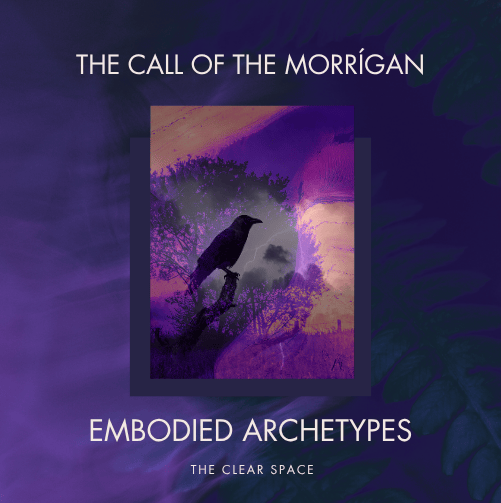
The Call of The Morrígan is a 60-minute somatic archetype journey exploring the three faces of the Morrígna; The Morrígan, Badb, and Macha. Through guided imagery, and embodied awareness, you’ll move through the energies of the void, the womb, and the sovereign, stepping into a space of power and transformation.
This practice supports you in connecting to inner authority, cyclical creation, and the deep wisdom of Celtic myth.
Themes: the Morrígna, sovereignty, the void, the womb, power, Celtic mythology, somatic embodiment.
Includes:
• MP3 audio journey
• PDF script + reflection prompts + ritual guidance
Perfect for lovers of Celtic myth, archetypal work, and embodied spirituality.
Other Ways to Work with The Void
Practice Spacious Presence: sit with the feeling of “nothing happening” without trying to fix, fill or solve it. Let the silence be a container rather than a problem. Notice what sensations or impulses arise when you stop pushing for clarity.
Work at the Edges: pay attention to threshold moments; the end of a breath, the pause before speaking, the moment after letting something go. These liminal edges are micro-portals into the Void and help build capacity for the unknown.
Let Something Die on Purpose: choose one pattern, habit, or identity you’re ready to release. Offer it consciously to the Void. Allow the emptiness that follows to be fertile ground rather than something to escape.
Do Nothing (On Purpose): set a short period of time where your only task is to not-do. This is not collapse, it’s intentional surrender. Notice how your nervous system responds when productivity or direction is gently paused.
Create From Darkness: begin a creative act; writing, movement, art without a plan. Start in the void of not-knowing and let form emerge organically. This mirrors the mythic pattern where creation rises from darkness before it takes shape.
The more faithfully you can endure here, The more refined your heart will become.
As I share in my blog post about archetypes, whether they’re viewed psychologically, spiritually, or both, archetypes can offer a framework for self-understanding and growth. When we create a space to explore our core patterns differently, this can facilitate shadow work, allow us to safely connect with repressed aspects of ourselves and support trauma healing by reframing personal stories.
To finish, I’ll share a poem that I read in a circle I held last year, where we explored the theme of the void in depth. I find the line “The more faithfully you can endure here, The more refined your heart will become” especially comforting when I think of my own journey with The Void. What happens when we surrender, release control and allow what ever comes next to arrive without striving.
For the Interim Time, by John O’Donohue
When near the end of day, life has drained
Out of light, and it is too soon
For the mind of night to have darkened things,
No place looks like itself, loss of outline
Makes everything look strangely in-between,
Unsure of what has been, or what might come.
In this wan light, even trees seem groundless.
In a while it will be night, but nothing
Here seems to believe the relief of darkness.
You are in this time of the interim
Where everything seems withheld.
The path you took to get here has washed out;
The way forward is still concealed from you.
The old is not old enough to have died away;
The new is still too young to be born.
You cannot lay claim to anything;
In this place of dusk,
Your eyes are blurred;
And there is no mirror.
Everyone else has lost sight of your heart
And you can see nowhere to put your trust;
You know you have to make your own way through.
As far as you can, hold your confidence.
Do not allow confusion to squander
This call which is loosening
Your roots in false ground,
That you might come free
From all you have outgrown.
What is being transfigured here in your mind,
And it is difficult and slow to become new.
The more faithfully you can endure here,
The more refined your heart will become
For your arrival in the new dawn.
from: “Benedictus, A Book of Blessings” by John O’Donohue, Bantam Press, 2007