The eco-somatics and psychology of horizons
Exploring the psychology of horizons through eco-somatics, metaphor and archetypes
This morning I sat on a hill and thought about the psychology of horizons. Back in May 2020, in the middle of the global pandemic, I got into my car and drove out of Birmingham, to a country park on the outskirts of the city. This was one of the first days since lockdown began, where it was permitted to to travel outside of the local area. I parked, walked up the same hill that I sat on today.
As the horizon came into view I cried the kind of tears that come from letting go of something you’ve been holding very, very tightly. Seeing the vastness of an open horizon felt like relief, after what felt like an eternity of looking at the four walls of my flat and the restricted views in my local, urban area.
“Recall the way mere mortals are overwhelmed by circumstance, how great reputations dissolve with infirmity and how you, in particular, stand a hairsbreadth from losing everyone you hold dear.” - from Mameen by David Whyte (full poem below)
If you’re new here, I’m Laura, a counsellor, nature therapist, somatic therapist and meditation teacher. My work centres around guiding people back into relationship with themselves, their bodies and the wider natural world.
If I’d trusted my memory when writing this post, I’d have told you that this encounter with a horizon happened towards the end of that year. When I checked the dates, I was surprised to learn that the first lockdown only lasted for a couple of months.
I lived alone during the pandemic and it felt like I spent endless months without seeing another human in person. I’m not surprised, then, that when I took my first step onto a hill, overlooking the West Midlands countryside, it felt lI could breathe for the first time in what seemed like forever.
As I sat on the same hill today, thinking about that experience and the psychology of horizons, I reflected on the layers of my experience, and how we connect with horizons through our somatic, embodied experience, as well as archetypes and metaphor. Keep reading for reflections on:
the psychology of horizons
horizons as metaphor and archetypes
a short eco-somatic practice with prompts for reflection
The science of Horizons
We live in a world that asks us to narrow our vision, and focus our awareness, attention and perspective. Our eyes and brains evolved for survival in the natural world; tracking moving prey, scanning landscapes, and looking towards distant horizons to anticipate opportunities, as well as threats.
Some researchers believe that broadening our visual attention can support nervous system regulation. This won’t be true for everyone. For some people, looking into the distance feels grounding. For others, it might feel neutral, uncomfortable, overstimulating, or unhelpful.
All responses are valid. Human nervous systems are more dynamic than on/off modes, and responses vary widely depending on stress, trauma history, sensory processing, neurotype, environment, and context.
We do know that, for many people, spending time in nature can be calming because it provides visual and sensory cues associated with safety, and reduces cognitive demands. It can also encourage a more mindful way of paying attention. As we become aware of our surroundings, we can find it easier to move away from habitual patterns, and connect with the present moment. Over time, mindfulness practices have been linked to lower stress, improved emotional wellbeing, and greater resilience.
The horizon leans forward,
Offering you space to place new steps of change.
Here, on the pulse of this fine day
You may have the courage
To look up and out and upon me, the
Rock, the River, the Tree, your country.
No less to Midas than the mendicant.
No less to you now than the mastodon then
From On the Pulse of Morning by Maya Angelou

Horizons as archetypes and metaphor
Psychologists increasingly recognise that metaphors are not just poetic devices; they can be a meaningful way of make sense of our experiences.
We speak about expanding our horizons, broadening our horizons, looking towards the horizon, or finding something on the horizon. Horizons can represent possibility, perspective, movement and change. A horizon, paradoxically, marks a boundary, and also represents what might exist beyond the boundary, outside of our awareness.
From an archetypal perspective, horizons can be found in myths, stories and spiritual traditions across cultures. The horizon is associated with journeys, thresholds and transformation. It is the place where the known world meets the unknown. Sailors navigate towards it. Pilgrims walk towards it. Heroes cross it.
In the Tarot, the Fool's Journey unfolds across the Major Arcana as a metaphor for life's unfolding horizons, with each card representing a lesson, archetype, or threshold that shapes the traveller's evolving understanding of themselves and the world. The Fool is depicted as a carefree traveller standing at the edge of a cliff, gazing upwards, rather than looking at the path ahead. This card represents optimism, trust, and the courage to step into the unknown.
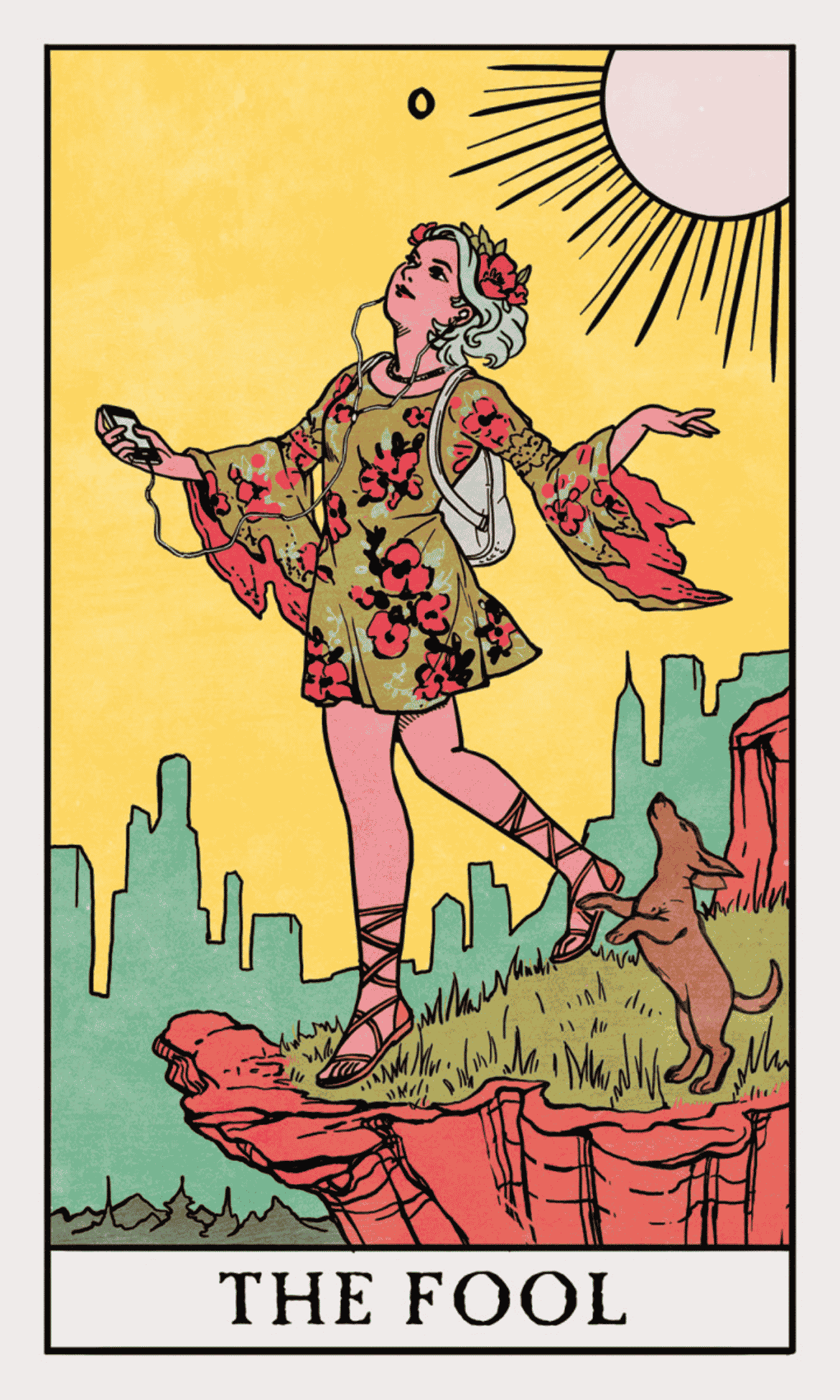
From Lisa Sterle’s Modern Witch Deck
Carl Jung described archetypes as universal patterns that live within the collective psyche. Horizons as an archetype might represent our innate drive for growth, our ‘self-actualising tendency’ as it’s known in humanistic psychology.
“we each, within us, have the capacity to sort ourselves out—to find the answers to our problems. If we get cut, our bodies form scabs to heal us; or send out antibodies to help us overcome an infection. In the same way, then, deep inside of us is a tendency towards psychological healing, maintenance, and growth. We know what is right for us: an amazing, organismic wisdom that can help us overcome even the most challenging of circumstances”
Mick Cooper
There is something very human about looking past our current circumstances. Horizons invite us into relationship with our internal and external landscapes and, as we look outward towards distance, maybe we can also find some new spaciousness internally. As the landscape opens, something in us opens too.
Recall the way you are all possibilities you can see, and how you live best as an appreciator of horizons, whether you reach them or not.
- from Mameen by David Whyte (full poem below)
An eco-somatic practice: meeting the horizon
As regular visitors to this space will know, I place a lot of value on experiencing things directly through the body, rather than only exploring them intellectually. With that in mind, here's a short somatic practice to help you explore your connection with horizons through felt sense.
Find a place where you can comfortably see into the distance. This might be a hilltop, a beach, an open field, or even a view from a window.
Take a few moments to arrive asking yourself, is there anything I need to be comfortable and supported in this space.
Feel your feet making contact with the ground beneath you. Notice the support of the earth.
Rather than focusing on a single object, soften your gaze and allow it to rest on the horizon line.
Notice what happens if you become aware of the full width of your visual field. See if you can include the edges of your vision without straining.
Now seeing what it feels like to move your gaze along the full length of the horizon. From left to right. Then back again.
As you continue looking towards the horizon, you could ask yourself:
What feels spacious in my life right now?
Where have my horizons become narrowed?
What lies beyond what I can currently see?
Checking in with yourself as you explore this. You could always come back to the feeling of your on the ground. Or bring your awareness back to the visual line of the horizon.
When you feel ready, bring your attention back to your immediate surroundings. Notice the ground beneath your feet once more. Notice the sounds, colours and textures around you.

Be infinitesimal under that sky
The hill I visited this morning hasn’t changed much since 2020. The trees are a little taller and we’ve shifted through a season or two. I reflected that horizon lines always seem fixed and steady, even when the world feels anything but. There's something interesting about that, given that horizons are also inherently liminal, existing at the threshold between what we know and what lies beyond our awareness.
This led me to wonder whether the horizon is also connected to the archetype of the void. Whenever the void shows up in my reflections, it's usually a sign that I've done enough thinking for one day and that it’s time to get back to being, what ever that might look like in the moment! I’ll save my reflections about why I am drawn to liminal spaces for another day.
Thanks for exploring the psychology of horizons with me. I’ll leave you with the full version of Mameen, by David Whyte. You can also find another of his writings about horizons here.
Mameen by David Whyte
Be infinitesimal under that sky, a creature
even the sailing hawk misses, a wraith
among the rocks where the mist parts slowly.
Recall the way mere mortals are overwhelmed
by circumstance, how great reputations
dissolve with infirmity and how you,
in particular, stand a hairsbreadth from losing
everyone you hold dear.
Then, look back down the path to the north,
the way you came, as if seeing
your entire past and then south
over the hazy blue coast as if present
to a broad future.
Recall the way you are all possibilities
you can see and how you live best
as an appreciator of horizons
whether you reach them or not.
Admit that once you have got up
from your chair and opened the door,
once you have walked out into the clean air
toward that edge and taken the path up high
beyond the ordinary you have become
the privileged and the pilgrim,
the one who will tell the story
and the one, coming back
from the mountain
who helped to make it