Connect with trees: forest bathing & tree meditation
Deepen your connection with nature through forest bathing, tree meditation and tree folklore
I was on a road trip with a friend recently and, having just spent some time in a beautiful woodland connecting with the trees, I reflected that younger me would probably be pretty amused (or confused?!) about how I spend my time these days. In my 20s I was into dancing in clubs (to trance mainly, but I also had an indie kid phase). These days I spend as much time in nature as I can and I get very excited about trees.
Back then I’d never heard of forest bathing (or shinrin-yoku). Partly because no one outside of Japan had, and partly because I hadn’t formed a connection with the natural world at that time in my life. I do remember feeling a sense of freedom riding through the woods on my bike as a kid, but outside of that I wasn’t that very aware of nature.
Stand still. The trees ahead and bushes beside you
Are not lost.
Wherever you are is called Here
From Lost by David Wagoner (full poem below)
These days I’m a counsellor, a nature therapist, a somatic therapist and meditation teacher and I do a lot of work around nature connection so a lot has changed. Spending time in woodlands and forests is one of my favourite things to do, and today I’m sharing some reflections on how you can connect with trees through tree meditation, somatic practices, and tree folklore.
In this post you’ll find:
the psychology and biology of forest bathing and tree meditations
tree spirituality and tree folklore
free somatic prompts to connect with a tree and a paid practice to explore this more deeply
the metaphorical and archetypal forest
If you’d like to explore more general resources around nature connection check out my post ‘reflections and resources for nature connection practices’

The psychology and biology of shinrin-yoku and being with trees
I am a firm believer that science eventually confirms what we intuitively know. In their forest walking guide, Decolonial Futures share that “many Indigenous cultures do not make a distinction between objects and subjects, or humans and nature. The rivers, the mountains, the trees, other-than-human, animals, and the forests themselves are experienced as conscious entities who are much older relatives and who, like human beings, require engagements based on trust, respect, consent, reciprocity and accountability.
And you must treat it as a powerful stranger, must ask permission to know it and be known. The forest breathes. Listen. It answers, I have made this place around you. from Lost by David Wagoner (full poem below)
Whether or not you believe that trees are conscious entities, it’s likely that you’ve experienced the calming effects of being in a forest, and the science around this is starting to catch up. Research by the University of Derby and The Forest Bathing Institute found that spending time with trees can significantly improve mood, reduce anxiety, strengthen our connection with nature and even support heart health. Inspired by Japan, where Shinrin-yoku has been prescribed for wellbeing for decades, these findings are helping to establish this practice as a recognised therapeutic practice here in the UK.
Mindful tree relating and relationship building
Our understanding of this process isn’t totally clear yet but it’s likely that a combination of physical activity, paying mindful attention, reduced exposure to urban stressors and immersion in natural environments contributes to improvements in mood and wellbeing. Studies have also reported changes in physiology including heart rate and, in some cases, cortisol which is the stress hormone.
The forest breathes. Listen. It answers,
I have made this place around you.
From Lost by David Wagoner (full poem below)
From a mindfulness perspective, spending time connecting with and observing trees means that we can start to notice details that we might usually overlook: the texture of bark, the structure of branches, the way the light falls, and the communities of mosses, fungi, insects, birds, and other life that a tree supports. This shifts the emphasis towards building the kind of relationship that Decolonial Futures talk about; ones that are based on trust, respect, consent, reciprocity and accountability
Trees, folk practice and the druids
Druids were the religious leaders of the ancient Celtic peoples of present-day England, Ireland, Scotland, Wales, and parts of western Europe. Some accounts suggest that Druids had special reverence for certain trees, particularly the oak and many academics believe that the word Druid comes from a Proto-Celtic term meaning "oak-knower”. Celtic people were believed to have worshiped in sacred places known as nemetons, some of which were woodland groves.
The Druids weren’t big on writing things down but more recent historic records, folklore, and modern interpretations of Celtic spirituality have beautiful links to trees and connection with them. The Ogham (pronounced oh-am) is a great example of this. In it’s earliest form, it’s the earliest known alphabet of Ireland, and it was used from around the 4th century to carve inscriptions on standing stones.
More recent interpretations of the Ogham have linked it to trees, with each ogham symbol connecting to a specific tree and period of the calender year, which has led some people to refer to this framework as tree astrology or a tree calendar. Each tree is thought to have its own energy and symbolism.
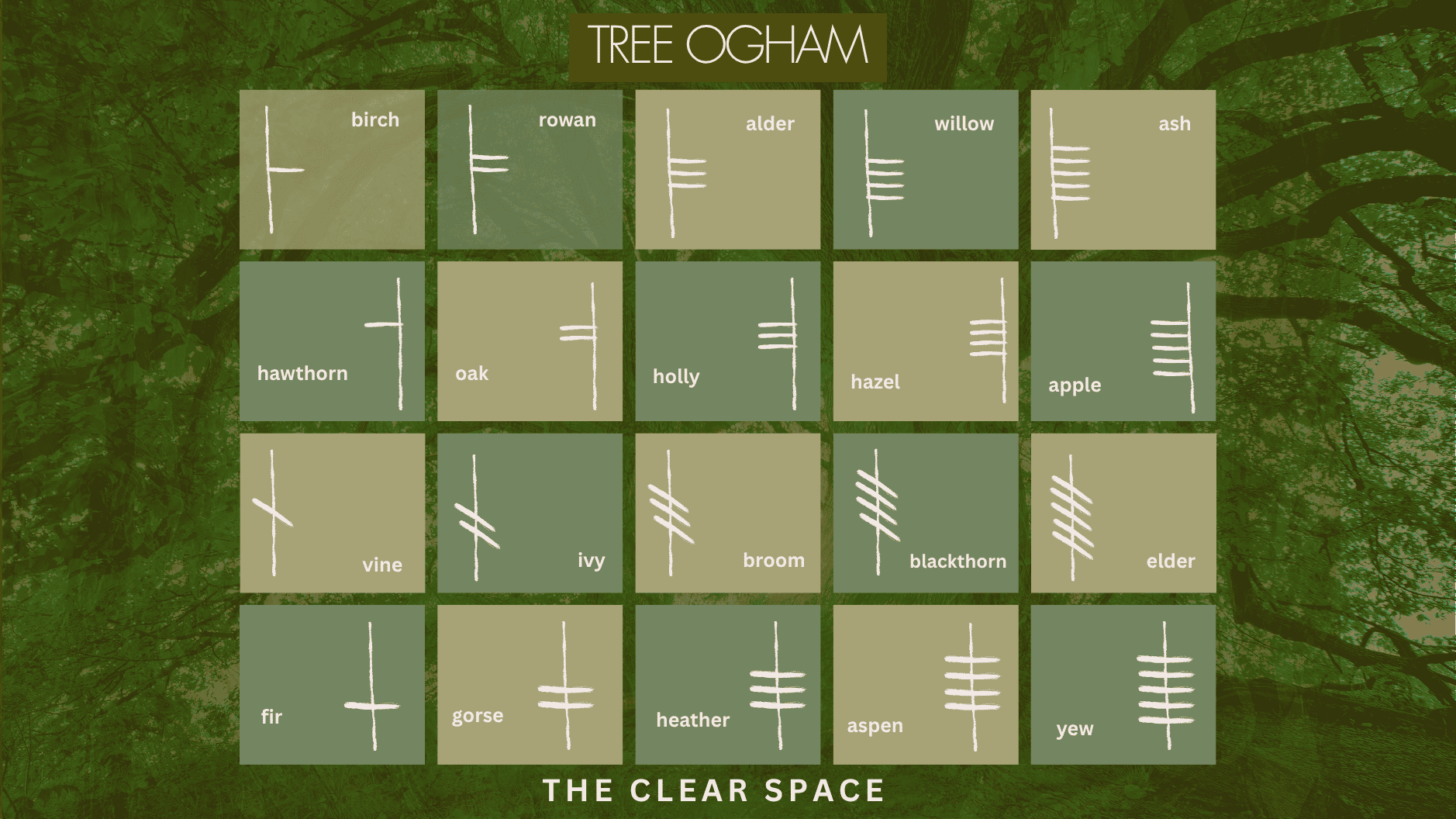
Two of my favourite trees are the oak and the yew. In the Ogham the oak is associated with sovereignty, enduring strength, and steadfastness, while the yew is connected with death, rebirth, transformation, and deep ancestral wisdom. If you’d like to explore this more, I love Glennie Kindred’s hand written book about the tree ogham.
The religious, folkloric and mythological significance of trees
This could be a whole post of its own because trees have spiritual and cultural significance across the globe.
In Buddhism, the Bodhi tree (Ficus religiosa, the sacred fig) is said to be the place where Siddhartha Gautama attained enlightenment and became the Buddha.
Across South Asia, the banyan tree is celebrated as a tree of longevity, shelter, and community.
In Islam, the Qur'an refers to trees as signs of God's power and uses them as metaphors for faith, and Paradise
In Christianity, trees can be found in the teachings of Jesus, while the Garden of Gethsemane, set among ancient olive trees, marks one of the most significant moments before his crucifixion.
In my own pagan based spiritual framework, as well as the significance of trees for the Druids, trees have significant roles in mythology and folklore.
The Hawthorn tree is associated with The Fae who, in stories of the Tuatha Dé Danann, are an ancient, magical race who are said to move between here and the "Otherworld", using the Hawthorn as a portal
In Welsh mythology, Lleu Llaw Gyffes is cursed by his mother, Arianrhod, to never have a human wife. The magicians Gwydion and Math create Blodeuwedd (Flower-Faced in Welsh) from Broom and Oak, to become Lleu Llaw Gyffes’ wife.
Hazel is another tree that’s thought to be magical, with witches wands often being made from its wood. It’s also been used for "water divining" or "dowsing", where hazel branches are used to divine or dowse the location of underground water sources
These are just a few examples and you’ll easily find more if you’re interested. These posts by academic folklorist, author and Fabulous Folklore podcast host, Icy Sedgewick are a great starting point.
The Willow and Magic
Meet the Oak, the Favoured Tree of the Forest!
Hawthorn Folklore: Fairies and the May Day tree
Yew Trees: Death, Churchyards, and Helpful Tools

A guided, somatic tree meditation practice
Trees are a beautiful model for community because they live in relationship. Underneath the ground, their roots connect with fungal networks that carry nutrients, chemical messages, and other forms of exchange. They recognise and support their young, pass knowledge across generations, and contribute to the life of the wider natural-community.
You are surely lost. Stand still. The forest knows
Where you are. You must let it find you.
From Lost by David Wagoner (full poem below)
Because we can learn so much from trees and their ways of related, I wanted to create a practice that explores this as part of my Somatic Embodiment Journeys series. It’s also inspired by my recent collaboration with the Midlands Arts Centre and artist Clare Hewitt, where we explored tree meditation, shinrin-yoku and somatic tree connection through Clare’s work ‘Everything in the Forest is the Forest’.
This practice invites you to meet, and enter into a reciprocal relationship with a tree, through movement, meditation, and embodied awareness. The audio guided somatic and embodiment journey explores what it means to be rooted, what wisdom a tree might offer and what we can learn when we meet it as a relation. You can check out other practices in my audio guided somatic journey series here.
Meeting a Tree is a 35-minute somatic meditation that invites you to begin a relationship with a tree. Through movement, meditation, and embodied awareness, we'll explore what it means to be rooted, what wisdom a tree might offer and what we can learn when we meet it as a relation.
Archetypal and poetic tree reflections
I’ll finishing by sharing some of my favourite words about trees. One of the oracle cards in the Unknown Archetypes deck by Kim Krans speaks about the forest:
Consider for a moment your earliest memory of The Forest. It's likely it included all the mythic dynamics of this archetypal space: a little fear, a little enchantment, perhaps losing your way, perhaps discovering a secret mystical treasure. Such is the magic of The Forest. It requires first that you enter it, and then that you get lost within it. You may think there is a path to lead you straight through, but soon enough you'll be on what is known as the pathless path. There are tricksters here, dense foliage, and entanglement. But equally present are the glimmers of fairy light and friends among the trees. You're on an adventure now, and there's no turning back, so embrace the dim light and the moving shadows. Whether literal or imaginal - brave The Forest and get lost getting found. - Kim Krans, Wild Unknown Archetypes Deck
And the poem ‘Lost’ by David Wagoner are the words that you’ll find woven through the sections above:
Lost by David Wagoner
Stand still. The trees ahead and bushes beside you
Are not lost. Wherever you are is called Here,
And you must treat it as a powerful stranger,
Must ask permission to know it and be known.
The forest breathes. Listen. It answers,
I have made this place around you.
If you leave it, you may come back again, saying Here.
No two trees are the same to Raven.
No two branches are the same to Wren.
If what a tree or a bush does is lost on you,
You are surely lost. Stand still. The forest knows
Where you are. You must let it find you.
Finally, here are some links to deepen your nature and tree meditation explorations:
Reflections and resources for nature connection practices
The eco-somatics and psychology of horizons
Leaning Into Darkness - an audio guided somatic nature meditation